Vous devez activer les cookies pour accéder à ce site.


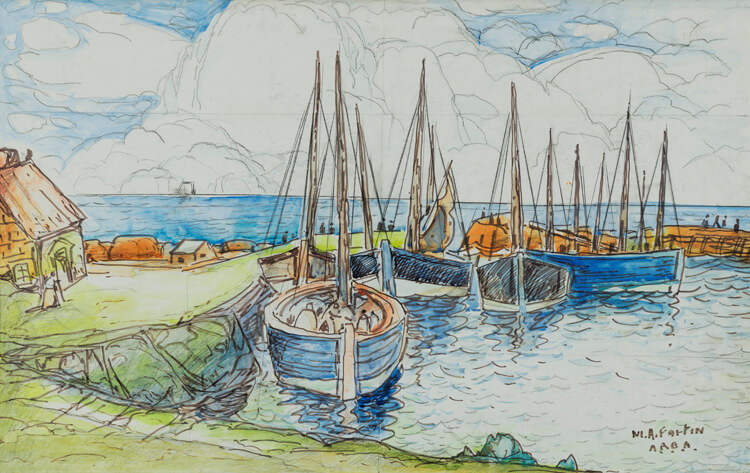

Marc-Aurèle Fortin ARC / RCA
A Québec painter and printmaker, Marc Aurèle Fortin was born on March 14, 1888, in Sainte-Rose and died on March 2, 1970, in Macamic (Abitibi). At age 15, he took drawing classes at the Académie commerciale catholique de Montréal as well as the École du Plateau under Ludger Larose and Edmont Dyonnet. However, his father, a judge, sent him to work in a post office in Edmonton, in order to discourage his son’s artistic aspirations. Fortin pursued his passion nevertheless and it was there that his career as a painter was born with the sale of one of his paintings for $50, quite a big amount for the time. In 1909, he decided to perfect his training in the United States, at the Art Institute of Chicago. Back in Québec in 1912, he continued to work as a clerk at a post office in Montreal while painting in his free time. He was introduced to watercolour painting but, unhappy with the results, he temporarily gave up this medium. In 1919, Fortin could at last dedicate himself to his art. He started painting rural and urban landscapes, the former enhancing the picturesque side of nature with oversize trees, rustic houses, hay wagons (his favorite subjects), the latter often depicting the Port of Montreal, the Hochelaga neighbourhood or Sainte-Rose, his hometown. He also returned to watercolour and created his famous ‘’sponge’’ watercolours. ‘’It is while practising on the Gaspé Peninsula mountains that I succeeded in mastering watercolour’’, he said. In 1934, he went to Europe for a few months (France and Italy) and brought back several sketches and drawings that showed a change in his style. As a matter of fact, his lyric side was now replaced by intense tones and thicker strokes. ‘’ All artists are influenced by others in their technique, in their craft. But a real artist preserves his Ivory Tower, which is impenetrable. The Ivory Tower is the area of inspiration, it's where the artist goes to get his ideas about art." (Marc-Aurèle Fortin, 1969). It is also upon returning from abroad that he experimented with his black manner ‘’ to intensify the relationship between shadow and light’’, and the grey manner ‘’to describe the warm atmosphere of Québec skies’’, he said. In addition to oil and watercolour (which he sometimes highlighted with charcoal), Fortin also took to etching, pastels and at the end of the 40’s, he painted with casein (a milk-based tempera). Fascinated by this medium and the striking tones that he could get, he dedicated himself almost exclusively to it until illness virtually stopped him from painting around 1955.
For over thirty years, Marc-Aurèle Fortin travelled across Québec to paint landscapes that would capture its soul. A very creative artist, he is considered one of the modern art pioneers in Québec mainly because of his very personal and original way of depicting nature and his innovative spirit in experimenting with various techniques. He participated in numerous international exhibitions and held individual ones at the Musée du Québec (now Musée national des beaux-arts du Québec) in 1954 and at the National Gallery of Canada in 1963. Among his prizes and honours are the Art Association of Montreal Jessie Dow Prize (1938), a bronze medal at the New York World Exhibition (1939) and associate member of the Royal Canadian Academy of Arts (1942). His artworks are part of several private and public collections such as Musée d’art de Joliette, National Gallery of Canada, Musée national des beaux-arts du Québec, Musée des beaux-arts de Montréal and University of Montreal. In 2011, the Musée national des beaux-arts du Québec dedicated the most impressive retrospective to Marc-Aurèle Fortin in over 45 years called ‘’Les couleurs d’un pionnier de la modernité’’.